
Saigon. Same Chaos. Same Ghosts. Same Broth. Different Me.
I returned to Saigon where the food was still perfect, the streets were still chaotic, and the only thing that really changed was me.

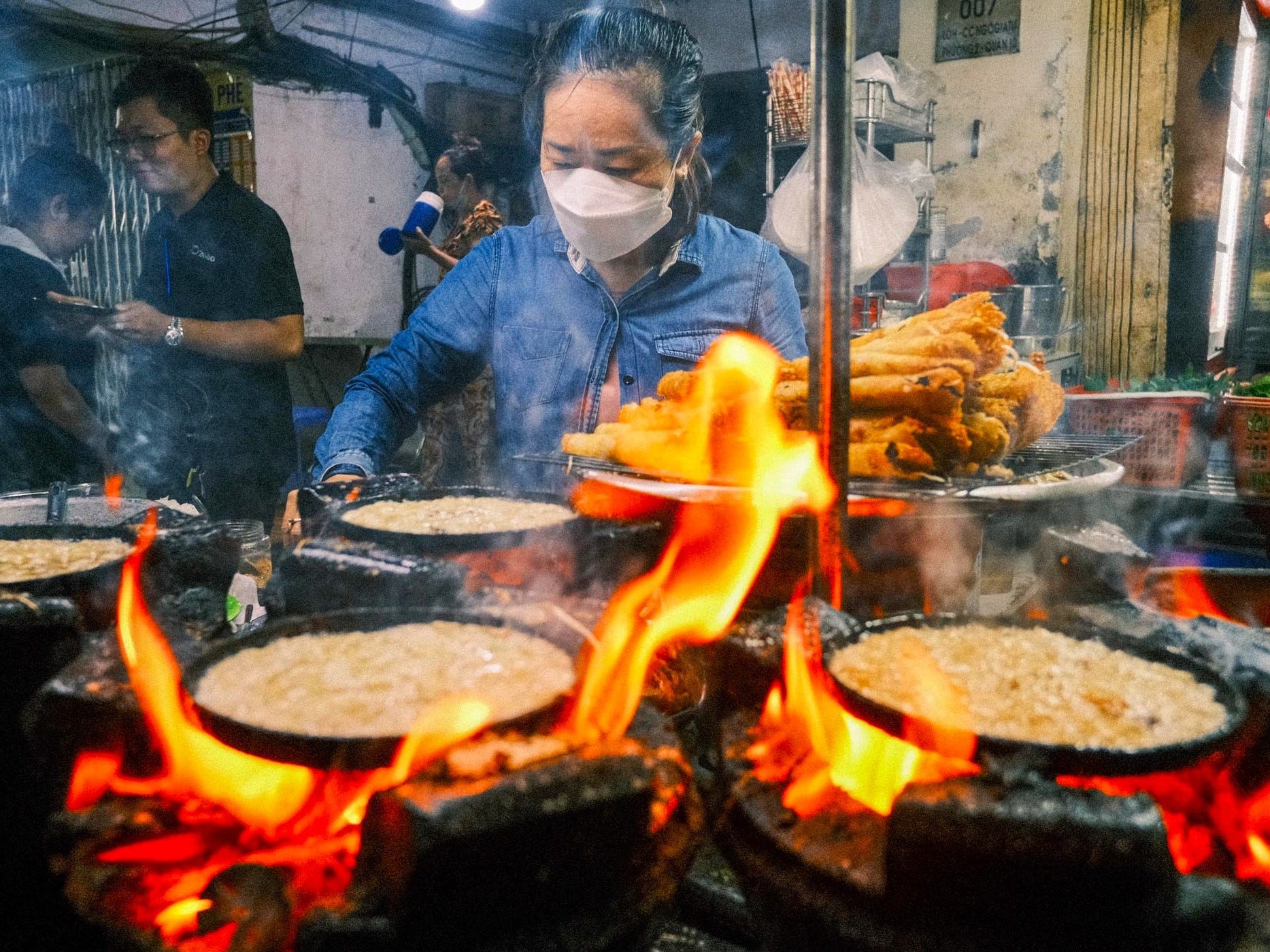
I came back to Saigon thinking I was the one doing the revisiting—that maybe I’d find the same streets, the same bowls, the same comforting illusions waiting patiently where I left them, and where I walked away. But the city had other ideas. It’s louder now, sharper, less interested in my wandering nostalgia and completely indifferent to my preconceived expectations. The bánh xèo still crackled, the broth still ran rich, deep and complicated. And somewhere between a handshake I really didn’t deserve, and a bowl I could never quite replicate, it became uncomfortably clear that Saigon moved on just fine without me. The real question was whether I could keep up.
Saigon never welcomed you back. It sized you up.
I stepped off the plane carrying whatever version of myself I’ve been living with—older, maybe softer around the edges, maybe harder in the wrong places. The city looked at me like a pit boss who’s seen it all before. No judgment. No warmth either. Just a quiet, unspoken tilt of the head as if to say “Let’s see what you’ve got left.” The heat hits first. It’s unmistakable. It’s never a gentle introduction. Instead, I was greeted with the all-to-familiar wet, enveloping grip—humid, intimate, and faintly accusatory. It smelled like diesel, grilled pork, overripe fruit, and something sweetly rotten just beneath the surface of it all. The kind of smell that reminded me that life here was constant, unfiltered, and absolutely indifferent to my comfort.
And that is exactly how it should be.
I’ve been away too long.
That much was obvious within minutes. The traffic has gotten worse—or maybe I’ve just lost the reflexes to dodge when needed. The skyline’s crept higher, glass and steel pushing upward like a reaching ambition made visible. But beneath it, in the seams where the city actually breathed, the old rhythms were all still present. They were never in plain sight, however. You have to go looking. But if you know where to look—if you’ve ever known anything at all—you end up back on a street like Sư Vạn Hạnh. The old street stretches between Ngô Gia Tự and Nguyễn Chí Thanh and it isn’t something you just stumble into. It’s something you return to. Something you remember. Something that carves itself deep into your psyche and never leaves. It calls to you. Or maybe it returns to you, pulling you back like a half-forgotten habit you never really kicked.
This street was a system. A circulatory network of heat, smoke, hunger, and small human negotiations happening in real time. Everything spilled outward here no matter where you stepped. Apartments bled into storefronts. Storefronts bled into sidewalks. Sidewalks dissolved entirely under the weight of grills, stools, and bodies in motion. You don’t walk through this place so much as submit to it. And everywhere—there was food. Not curated. Not elevated. Not explained. There was no definition required.
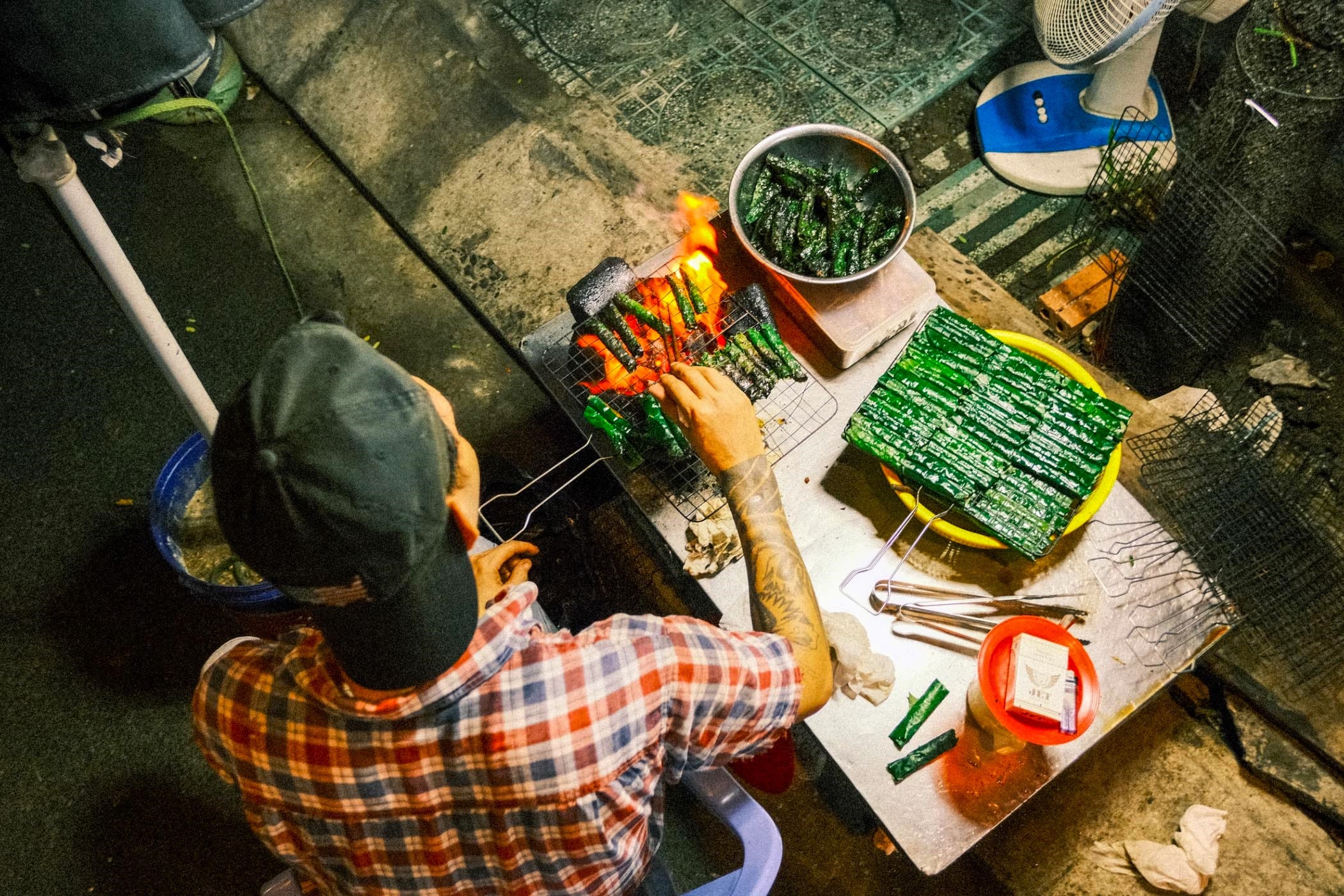
There were thousands of small operations running on instinct and repetition. Owners waking up while everyone was still slumbering. Coal fires lit before dawn. Broths that have outlived relationships. Recipes carried in muscle memory and never written down because they didn’t need to be. I could smell the street before I saw it. Charcoal and fish sauce. Sugar hitting heat. Fat rendering down into something dangerously close to perfection. Herbs crushed between fingers, releasing sharp green notes that cut through the heavier, darker smells like a blade. It’s overwhelming if you’re not ready for it. And, if you were ready for it, it’s still overwhelming—but in a way that felt necessary. Nostalgic. Welcoming. Lô H. Block H. Here, street names and areas all sounded almost bureaucratic and sterile. That is, until you’re standing in the middle of them, sweating through your shirt, watching a dozen simultaneous acts of creation unfold in front of you.
007 Lô H.
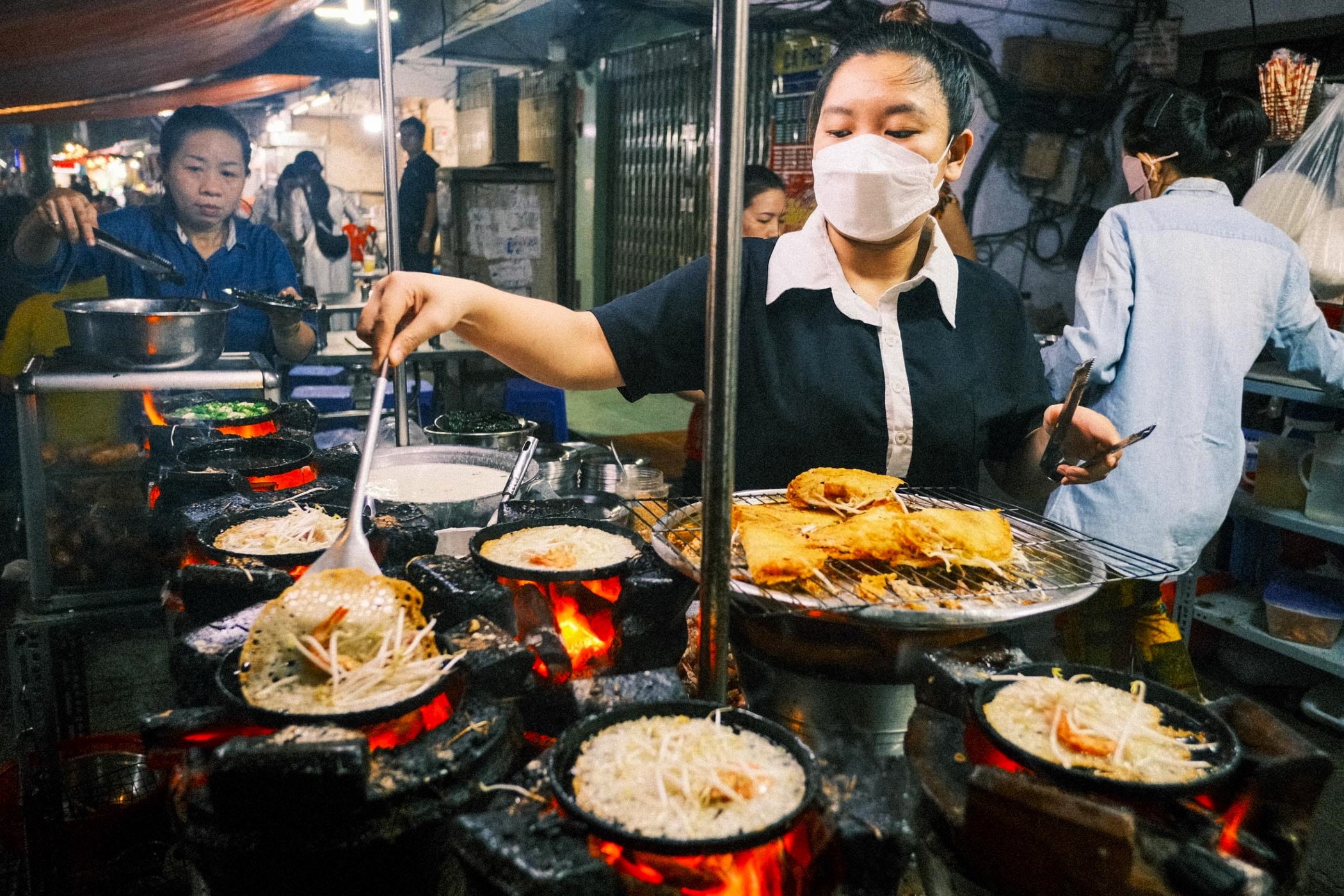
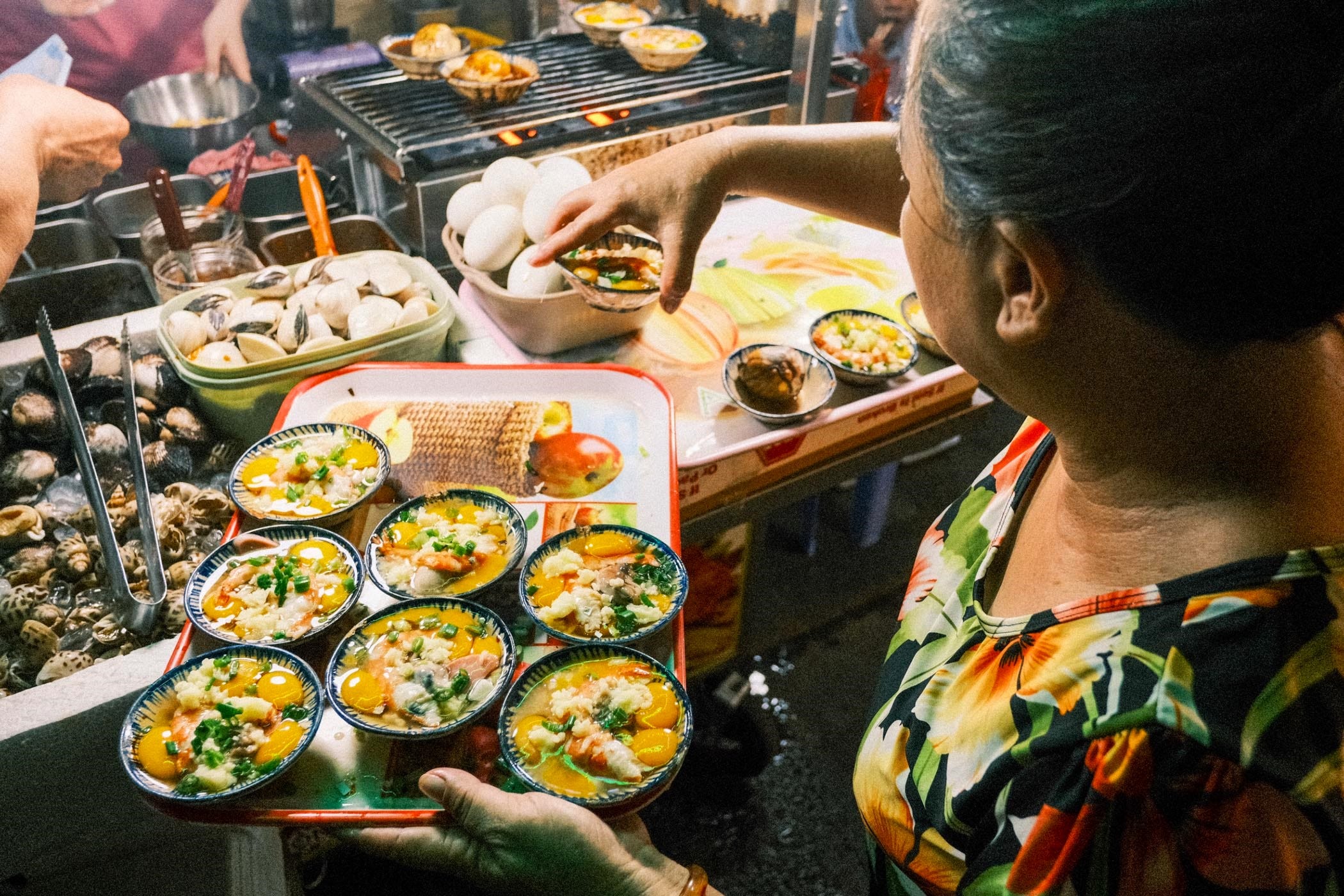
There’s something perversely perfect about finding some of the best food in your life at an address that sounds like it belongs to a low-budget spy film. This is bánh xèo country. It’s not polite. It’s not Instagram-ready. This was the real thing. I heard it before I saw it. It was that violent, immediate sizzle as batter hit metal. A sound that felt gripping, alive, reactive, and almost confrontational. Turmeric-stained liquid spread across a pan, edges crisping, curling, and protesting. Pork followed. Shrimp after that. Bean sprouts were shoved in with a kind of aggressive generosity that suggested restraint was not part of the philosophy here.
The cooks don’t look at me. They didn’t need to. They’ve all seen me before, in a thousand different forms. The hungry foreigner. The curious outsider. The temporary participant in something that existed long before I ever arrived. And something that will continue moving long after I leave. The cook’s focus was absolute. Flip. Fold. Plate.
Again.
And, Again.
And, Again.
And, again.
The repetition was hypnotic. There’s no wasted motion, no flourish. Just efficiency and muscle memory honed into something that bordered on grace.
I sat on an old plastic stool that hovered low to the ground. Knees high, posture compromised, and dignity negotiable. The plate arrived swiftly, and I dug in with the velocity of a famished ghost. I wrapped my bites in greens—mint, basil, things I couldn’t name but trusted anyway. I dipped into sauce that walked a tightrope between sweet, sour, and something far darker. Something fermented. Something that lingered in the air, on my tongue, and in my nose.
It’s messy.
It’s good.
Food should be messy sometimes.
And just a few steps down, the tone shifted completely.
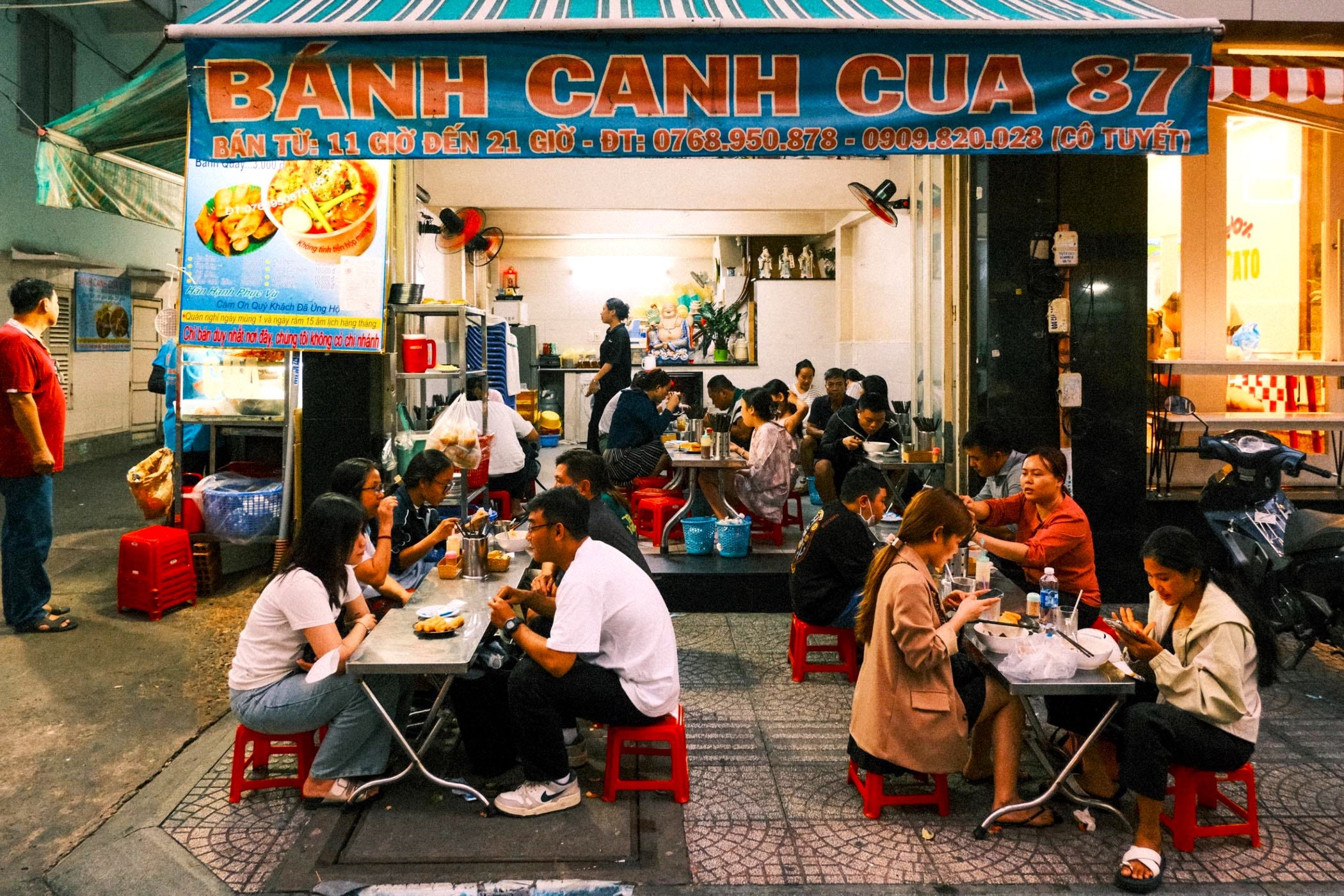
029 Lô H.
Bò Kho Gánh.
Michelin got here. Of course they did. Michelin gets everywhere, and all over everything, eventually. They are of-course drawn by the same thing that drew everyone else, but armed with a different vocabulary. Stars. Lists. Recognitions. They were all the language of validation. There were clean lines. Thoughtful designs. The kind of lighting that suggested someone, somewhere, made a decision about how this experience should feel. It wasn’t bad. It’s just different.
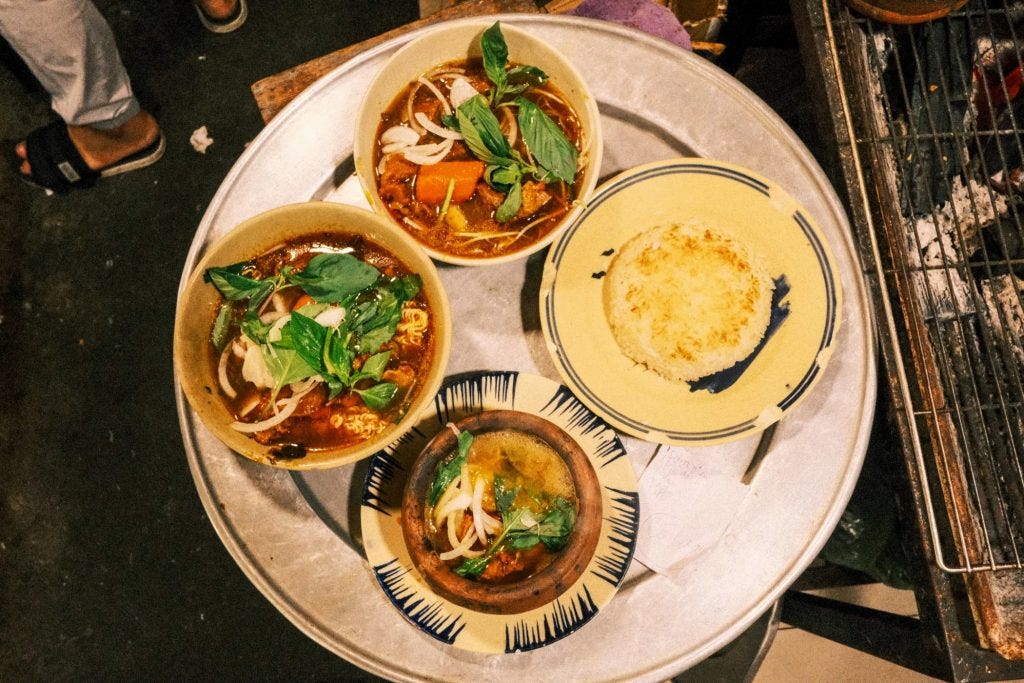
I grabbed a chair here and ordered the bò kho. When the server put the plate in-front of me, I understood why Michelin came here. The broth was deep—layered, patient, and brooding. The beef gave up the fight entirely, collapsing under the weight of time, patience, and heat. Lemongrass threaded through it all, proving that this wasn’t some generic exercise in refinement. It’s still vibrant. Still honest.
Well…..Mostly.
There’s a question hanging in the air, whether anyone wants to say it out loud or not. What happens next? Because, let’s be honest, recognition is never neutral. Recognition brought money. It brought attention. It brought people like me, coming back, looking for something we remembered, something that we experienced—something we’re not entirely sure still existed.
Recognition also brought something that we struggled to accept. Recognition brought change. The apartment block that used to anchor this stretch? Gone. Erased in the name of improvement. You can argue the necessity of it. Maybe it’s better living conditions, or safer structures, or more space. And you know, you’d be right. But standing here, watching the street operate at full tilt, I couldn’t ignore the other side of that equation.
What gets lost when things start getting fixed?
What disappears when the rough edges are sanded down?
What vanishes when chaos is reorganized into something more legible and more marketable?
Does flavor survive optimization?
Does soul survive success?
I never got answers to those questions here.
I just kept eating.
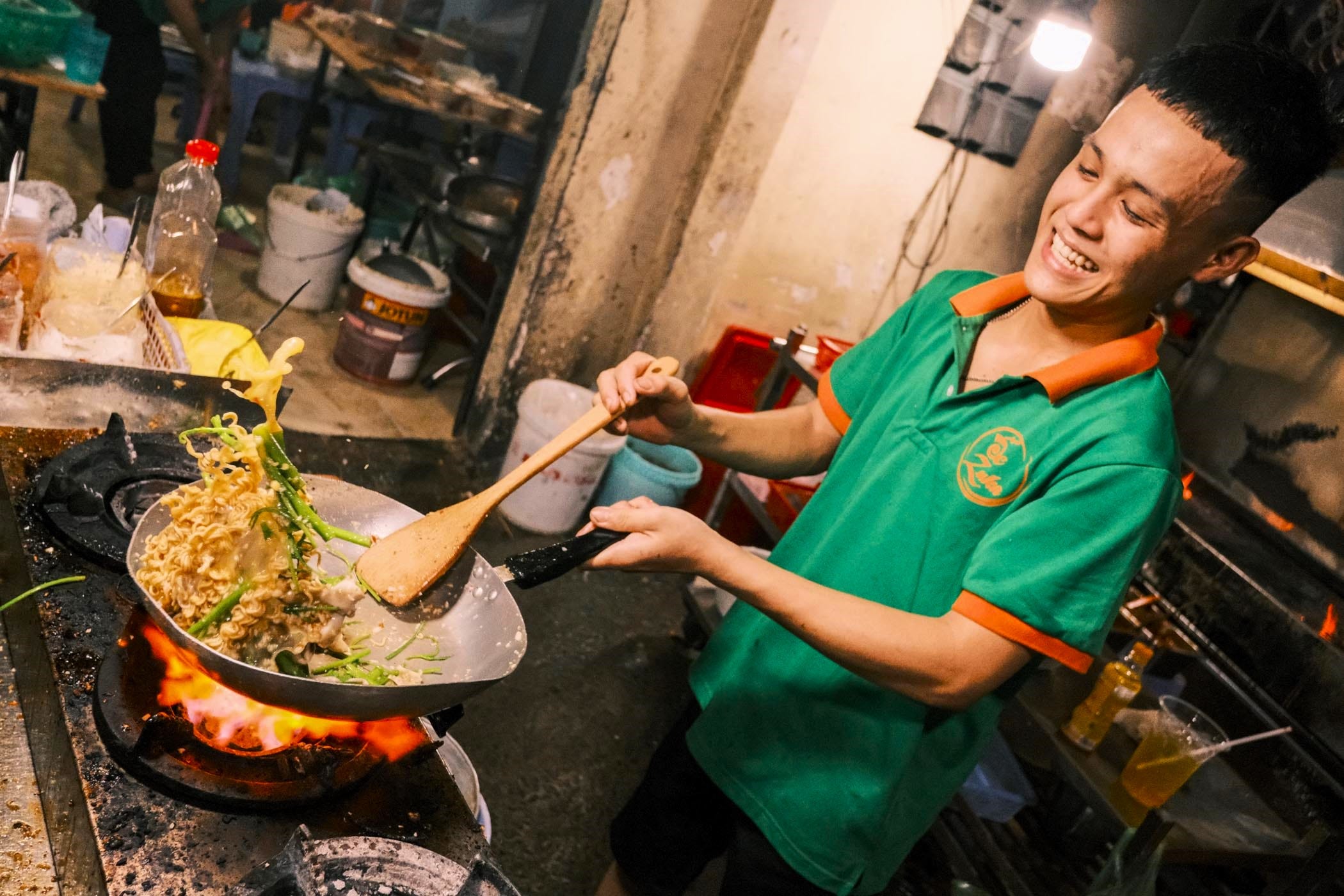
Tai Phát. A delicious Chinese-style noodle outlet.
The corner of Hòa Hảo.
This corner slice of culinary nirvana looked like it was pulled from another decade and simply refused to leave or change. Painted dragons curling along its sides, colors slightly faded but still defiant. Scenes from mythology that never asked to be understood. They only asked for our attention. This is where continuity lived.
I step up and smile. But, before I can speak, the cook, she sees me. Really sees me. There’s no hesitation. No polite confusion. Just recognition that cuts through time like it’s nothing at all. Her hand grabs mine—firm, warm, and immediate. And just like that, all of the years collapsed in front of me.
I’ve been gone too long. It’s not sad. It never needed to be. I nodded. Mostly because, here, I was the foreigner. The bumbling idiot who barely knew five words in Vietnamese. In a place like this, absence could never really be explained. It could only he acknowledged.
I ordered mì vịt tiềm. Some decisions didn’t require any thought at all. Just a memory of the taste and of the experience. And also the current pronunciation.
I sat. The stool creaked slightly under the weight of accumulated history—mine, the cook’s, the countless others who’ve passed through here, chasing the same thing. The bowl arrived quickly. Dark broth. Herbal, almost medicinal in its depth. Duck that’s tender without being sentimental about it. Egg noodles that held just enough resistance to play with my memory.
First bite. First slip. Broad smile.
And there it was.
Not nostalgia. Not quite.
It was something sharper.
Recognition, maybe.
Deep pleasure. Sublime enjoyment. Solitude.
There is something here for everyone. Don’t like what you see? Don’t worry. You won’t go hungry. If you don’t like one street vendor, well…there are fourteen other options just waiting for you to discover them. That’s the generosity of this place. It doesn’t insist. It offers. A friend once told me—take street food home, and it dies. It just doesn’t taste the same afterwards. You can’t capture that same flavor, that same experience, in that one, special moment. And you know, he was right. You can replicate the ingredients. You can follow all of the steps. You can even get close and observe the handiwork. But you can’t recreate this. Not really.
You can’t recreate the heat pressing in from all sides. You can’t reproduce the constant hum of movement, engines, voices, metal on metal, pedestrian traffic, greetings, and a legacy of flavor. And you definitely can’t copy the way your attention is split between your food and the immediate, very real possibility of being clipped by a passing motorbike. You can’t replicate the smiling chef who remembers you, and wants to cook something special for your return. And most importantly, you could never replicate the feeling that you are, briefly, part of something that doesn’t care whether you understand it or not.
That’s the ingredient you can’t import.
Saigon wasn’t a backdrop.
It’s an active participant.
It changed the way things tasted.
It changed the way I tasted them.
And maybe—when I let it in—it changed me a little too.
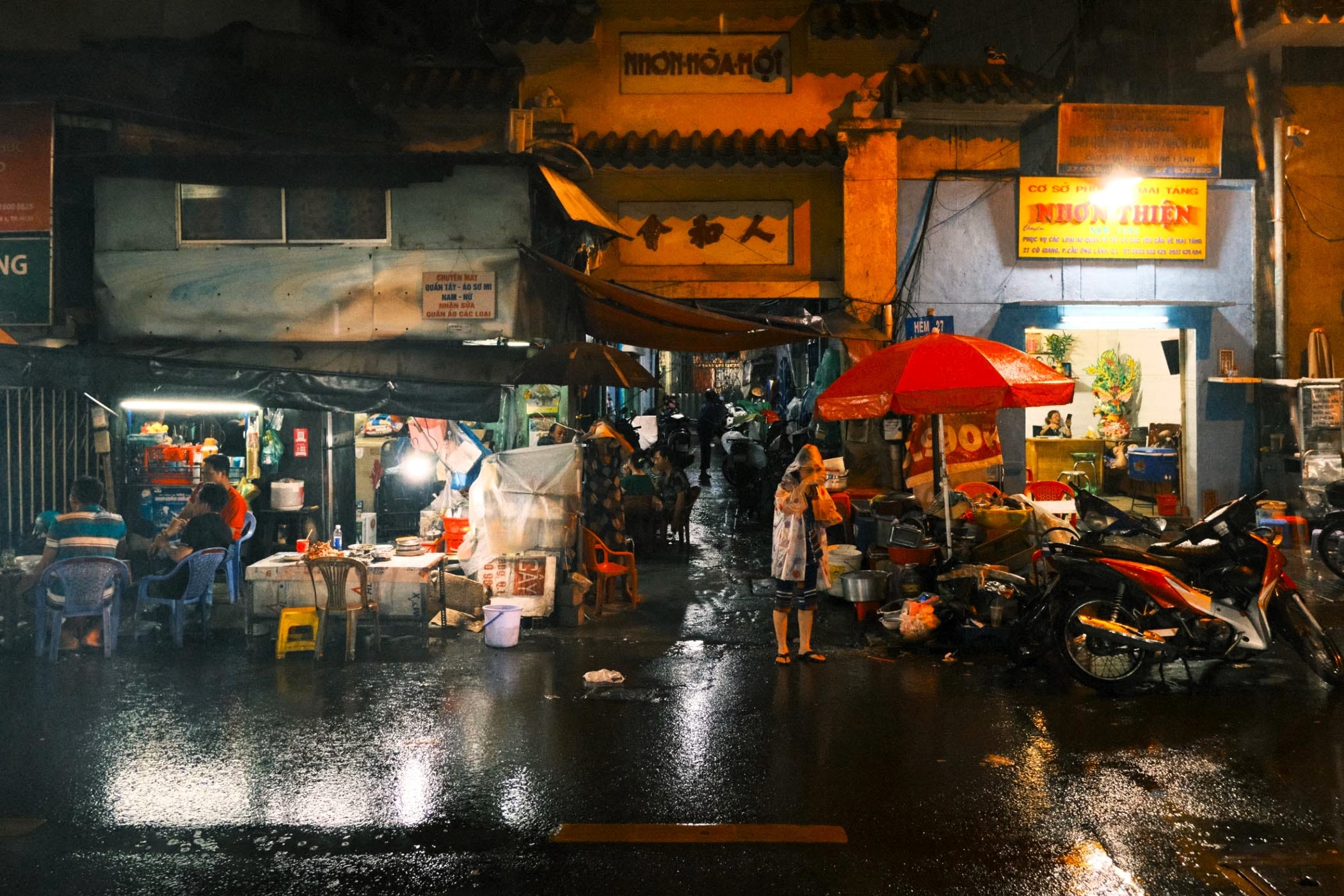
But change cuts both ways. Change can be seen in the new buildings rising where old ones once stood. In the subtle shift from necessity to presentation. In the way certain places started to anticipate an audience that wasn’t local. Food tourism was a strange beast. It preserves and it consumes. It celebrates and it distorts. It shines a light and, in doing so, sometimes burns hotter than intended.
Will the rest of Lô H survive as it is? Probably not. Nothing ever truly does. The question, really, is what it becomes. And whether, in that transformation, it can hold onto the things that really matter. The friction, the density, the small human moments that don’t translate well into reviews, ratings, or stars.
Here, there’s no rush. You finish, when you are done. There’s nowhere else I needed to be. Around me, the street continued—unbothered, relentless, and alive in a way that felt both fragile and indestructible at the same time. I stood, walked over to the cook behind the stall and gently pressed some bills into her hand. She smiled. It was a smile that told me not to wait that long until my next visit. I stepped back into the current—into the noise, the heat, the smell. I didn’t come back to Saigon to find what I left behind. I came back to see what survived without me. And luckily, found that some of it still recognized me. If only for a moment.
Even if I wasn’t entirely sure that I recognized myself.